

India Testfires Agni-5 Missile as Strategic Warning to China
India Increases Nuclear Deterrent
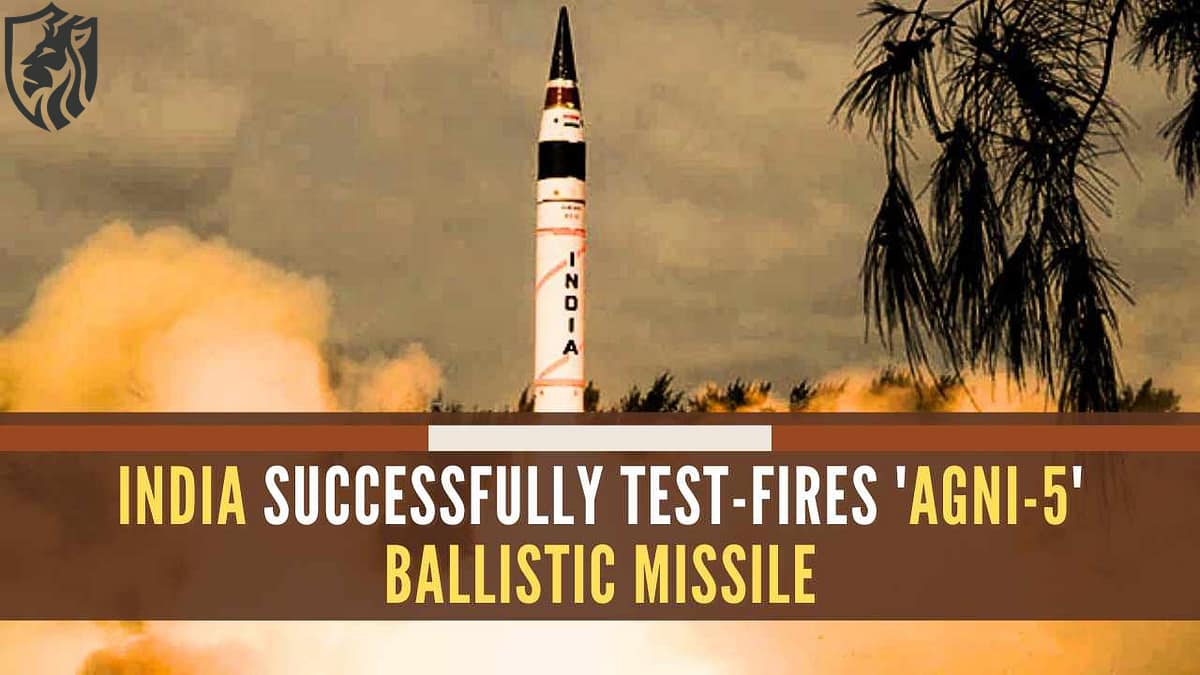
India test-fired the Agni-5 missile as a demonstration of its improving capability in long-range strategic deterrence. The test was carried out in Odisha, where the indigenously developed intermediate-range ballistic missile successfully met all the given operational and technical parameters. With a range spanning more than 5,000 kilometres, the system ensures that both China and Pakistan remain within its reach.
India successfully tested the Agni-5 missile as a part of its overall deterrence policy, reflecting its aspiration for credible nuclear weapons in the context of regional threats. The weapon’s ability to deliver nuclear warheads underscores India’s search for assured second-strike capability, a core aspect of its national security policy.

Escalating Hostilities Along the Himalayan Border
India successfully conducts a test of the Agni-5 missile at a time when relations with China are still tense following deadly clashes along the border in 2020. Strategic competition has only intensified as Beijing pushes its presence in the Indo-Pacific. By reaffirming this capability, New Delhi is both sending a message of assertiveness and eagerness to counterbalance China’s military ascendancy.
Analysts argue that India’s test launch of Agni-5 aims more to placate domestic constituents than to boost military morale. They argue that this provides policymakers with a bolstered hand in top-level negotiations and greater bargaining clout on Prime Minister Narendra Modi’s next trip to Beijing.
Nuclear Balance in South Asia
India had a test firing of the Agni-5 missile, coinciding with the comments of international think tanks on China’s growing nuclear imbalance. The Stockholm International Peace Research Institute (SIPRI) has noted that China has around 600 nuclear warheads, while India has 180.
Given this giant disparity, India’s ballistic missile capabilities extend deterrence far beyond its immediate regions. India test-fires the Agni-5 missile to bridge this capability gap, making its nuclear deterrent survivable and credible. Through emphasis on stable missile delivery systems, New Delhi balances the asymmetry with China and achieves balance in the unstable strategic equilibrium of South Asia.

Technological Advantages of the Agni-5
India has successfully test-launched the Agni-5 missile to validate advanced missile technologies. It uses solid fuel propulsion for reliable performance over long ranges. The system includes accurate navigation to ensure precise payload delivery. Re-entry vehicle protection keeps the missile safe through intense atmospheric conditions. These features confirm the missile can strike distant targets with accuracy.
Developed by the Defence Research and Development Organisation, it highlights India’s growing defence industry. The Agni-5 test is not just a show of strength. It also demonstrates India’s steady progress in strategic technology. The successful trial reassures that India can deliver advanced systems consistently. It increases the defence community’s credibility by producing sophisticated weapons.
Strategic View
India conducts a test-fire of the Agni-5 missile in the wake of the rapidly changing Indo-Pacific strategic environment. While China is accelerating the modernisation of its nuclear triad, India is consistently developing platforms like Agni-5 and Arihant-class submarines. Experts say that stable deterrence through platforms like Agni-5 is the way to prevent escalation and ensure stability.
India testfires the Agni-5 missile to boost defence preparedness while continuing to negotiate with neighbours. This dual strategy—building hard power and negotiating—lies at the centre of New Delhi’s security policy.
References
- https://www.drdo.gov.in
- https://www.sipri.org
- https://missilethreat.csis.org
- https://www.reuters.com
About the Author