
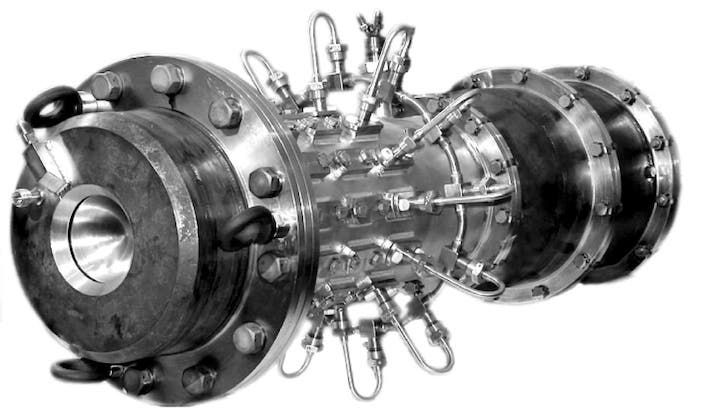
Rostec Pulse Detonation Engine
China has made outstanding strides in space technology by creating a revolutionary pulse detonation engine (PDE). This new way of propelling works in bursts instead of constantly burning fuel like traditional rocket engines do. This makes it much more efficient and faster. The detonation-based cycle also lets you use fuel more efficiently, which could lower costs and improve performance. Because of this, China’s investment in PDEs shows that it is serious about cutting-edge aerospace innovation and makes it a strong candidate for the next era of space propulsion. China is currently leading the way in next-generation propulsion systems with this technology, which could change space travel and hypersonic flight.
Pulse Detonation Technology
On the other hand, a pulse detonation engine operates by creating perfectly timed explosions at regular intervals. These explosions make enormous shock waves that can move rockets or planes. They use less fuel and produce a lot more thrust. The most important part of this method is the detonation waves, which move faster than sound and carry more energy than regular combustion. The result is a system that can move faster and use less fuel, which is excellent for space travel and hypersonic flight.

Pulse Detonation Benefits
The evolution of pulse detonation engines (PDEs) offers several benefits compared to traditional propellant systems:
1. Improved mileage on Gas
One of the best things about PDEs is that they provide you more thrust with less fuel. Conventional engines run all the time, but a PDE bursts the fuel in pulses, which makes energy conversion more efficient. This means that rockets and planes can go farther without using more fuel.
2. Faster Velocity
The shockwave-based propulsion system could make PDEs go hypersonic, which would cut trip time by a lot. Spacecraft could reach orbit faster at Mach 5+ speeds, which would lower the cost of lift-off and make space travel more cost-effective.
3. Reduce Running Costs
Reduced running expenses follow a lower fuel consumption. Furthermore, PDEs boast a simpler mechanical design than conventional turbine engines, which reduces manufacturing and maintenance expenses.
4. Multifarious Application in Space
Researchers are mostly looking into PDEs for rocket propulsion, but they could also change air travel. Long-distance flights would take an hour or two instead of days, and hypersonic passenger planes powered by PDEs would make travel across continents much faster.
China’s Space Ambitions and PDEs
China has been steadily investing in new propulsion technologies to improve its ability to go into space. PDE is part of a bigger plan by China to make better space and defense technologies for the next generation. These advancements encompass improved rocket propulsion, reusable space vehicles, and hypersonic missiles.
Space Exploration Impact
PDEs would help China make her space operations much more effective. Rockets that are faster and more efficient would lower the cost of sending cargo into space. This would make it cheaper to build bases on the Moon, go to Mars, and explore deep space. PDE-propelled spacecraft can also increase payload capacity, which makes it possible to send bigger scientific payloads, satellites, and even people on trips to orbits outside of Earth.
Military Role of Hypersonics
China’s PDE technology has important military uses in addition to civilian uses of rocket propulsion. More propulsion makes it possible for hypersonic technology to build hypersonic cruise missiles and reconnaissance planes that fly faster. Through the DF-ZF hypersonic glide vehicle, China has previously demonstrated its hypersonic capability. PDEs’ applications on military platforms help increase their strategic capability even more.
Worldwide Rivalry and Influence
China is the first country in the world to develop PDE technologies for aircraft. But other countries, like the US, Russia, and the European Union, are also looking into propulsion technologies that are similar. The hypersonic race is getting more intense as countries try to make engines that are faster, more efficient, and harder to see. If China can use PDEs well on current spacecraft and hypersonic planes, it will have a big edge in space exploration and defense technologies. This could make countries more competitive on a global scale and possibly lead to new space treaties or laws that govern how hypersonic technologies are used.

Challenges and Next Steps
PDE technology presents various engineering and execution difficulties even if its potential benefits are outstanding:
- High-tech materials and cooling systems help keep the engine from breaking down by controlling the enormous amount of heat that comes from multiple explosions.
- The development of stronger materials is necessary for structural durability, as pressure waves have the potential to rapidly wear down engine components.
- Extended flight and thrust control depend on proper timing from which to manage detonation rate and stability.
What China Does Next
China’s successful PDE development is just the beginning. Engineers will have to keep improving the technology, test it a lot in flight, and use PDEs on spacecraft and hypersonic planes if they want it to be fully operational. In the future, China may use low-cost, reusable spaceplanes and PDE-powered spacecraft to launch satellites and maybe even travel between planets. If optimized and scaled, these kinds of engines could entirely change how people explore the planet and travel through space.
Conclusion
China’s success with pulse detonation engines is a big step forward in the field of aeronautical engineering. PDEs are a revolutionary method in the military and space because they let you capture the energy of an explosion, which makes things run faster, more efficiently, and at a lower cost.
The world will be watching closely as China pushes the limits of new propulsion technologies. PDEs will definitely change the future of aerospace for the next few decades, whether they make space flights faster, allow passenger planes to fly at hypersonic speeds, or change the way the military uses them.
References
- South China Morning Post—China’s Hypersonic Advancements and PDE Research
- Global Times—China’s Breakthrough in Pulse Detonation Engine Technology
- NASA – Pulse Detonation Engine Research and Potential Applications
- The Diplomat—China’s Military Use of PDE in Hypersonic Missiles
- Defense News—Global Competition in Hypersonic and PDE Technologies
About the Author